
Filed under: Edinburgh
Session 1: Moments of Truth
George Papandreou – Former Prime Minister of Greece
First a note on Papandreou’s appearance and the ensuing demonstration. The TED folks warned us about the demonstration – suggesting that we turn our name tags around so that no one would know who we were. Turns out the demonstration was quite small and any advanced warning unnecessary – but I guess better safe than sorry.
Papandreou spoke about the failure of leadership – claiming that the people have been taken out of the process of politics. Greece, he explained had been used as scapegoats in the economic meltdown. By the time he had been named Prime Minister the unemployment, which had been described as 6 percent was actually more than double that. He went to the EU meeting thinking that the problem would be solved on a regional level. What he found was that the problem of Greece was solved hurriedly to beat the opening of the market in Japan. Papandreou said we need to restore confidence in government , we need to work on youth unemployment and our lack of creativity and compassion. Use Europe as a global model, he suggested. Give immigrants in the EU European citizenship as a step to developing a common identity that could become a democracy.

Steve Howard – IKEA
Three billion people will join the Middle Class by 2030. We’re seeing temperatures increase due to global warming. Populations in cities are growing. The rise of populations, especially in urban areas will create environmental issues. Businesses need to step up to be stewards of the environment. IKEA has already done this with an expectation of 100 percent goals towards being environmentally friends with things such as LED light bulbs, solar energy and a code of conduct in their supply chain to encourage environmentally sound decisions and prevent child labor. Businesses need to measure their impact on social concerns and shouldn’t be afraid to go all in.
George Monbiot – Journalist
George has plans to rewild the world – by that he literally means introduce wildlife – plants and animals into the ecosystem. He talks about lions in Trafalgar Square – and not the lion statues. By allowing wildlife to emerge again that will allow for rewilding of human life. His ideas were very out there – but interesting, starting with the idea that we can ecologically bored.
MUSIC – Tariq Harb – played guitar
Manal Al-Sharif – Women Can Drive
Manal became an accidental activist women’s rights in Saudi Arabia by driving. The common law belief in Saudi Arabia was that women couldn’t drive, although there actually was no such law. But when Lanal drove she and her brother (who has lent her the car) were both detained. A video of her driving raised even more questions. Her actions and a concerted effort to create a day when hundreds of women drove led to a change – women now drive in Saudi Arabia but it left Manal with a dual identity of sorts. She became a hero outside of her community but a villain within her country. A funny example was two hashtags used to track her actions: #oslotraitor and #oslohero.
Anne-Marie Slaughter – US State Department/Mother
Anne-Marie spoke about reassessing the feminist narrative. She had a big job with the US State Department and gave it up to stay home with her kids, when we kids were a bit older. (Teenagers, not toddlers.) It was a very thought-provoking talk and many people seemed to have an opinion on it. I think her best point was the need to socially lift up the role of staying home with kids. As she said, making a place for those we love is a global imperative – but often there’s not much social street cred that goes with it. She said we need to re-socialize men to be comfortable making the decision to stay home. I think staying at home could use a good PR campaign with both genders.
Session 2: Flying Things
Raffaello D’Andrea – Autonomous Systems Visionary
Raffaello gave a demonstration on drones and spoke about how they work. They are agigle but unstable. They can be programmed, but they can’t necessarily learn and adapt.
Lin Pin Koh – Drones Ecologist
Lin Pin advocates for positive use of drones as a means to view and monitor wildlife. He gave a range of positive puposes for drones:
- Survey wildlife populaiton
- Take pictures of animals and habitats
- Zoom in and out for patterns
- Create a map of landscape
- Create 3D models of forests
- Thermal imaging
- Camera traps
- Track radio collars
- Access remote areas with microphones
Andreas Raptopoulous – Greek Activist
Promotes drones as a positive means for providing service to people with no access to roads. Apparently 1 billion people have no access to roads. So his idea is that drones could be used to deliver medicine and other follow up to telehealth care. Infrastructure required to do that would include: flying machines (drones), landing stations and routers. They are testing this in some emerging communities. The thought is that it could also work in future urban locations where the shortest distance between two points might include a flight rather than road transport. His motto – Matternet will do for transportation what mobile did for communication.
Daniel Suarez – Sci-Fi Thrillers
Daniel spoke to the nefarious side of drones, lethal autonomy and fear of the anonymous war. There are three ways war becasome less human with drones:
- Deluge of video from drones
- Electronic jamming
- Plausible deniability
In a war with drones citizens in high tech societies are most vulnerable. The deluge of data will provide opportunities for folks who can recognize patterns and anomalies. The secret to minimizing impact of drones on warfare is transparency.
Music – Elizaveta – Musical Alchemist
Greg Asner – Aerial Ecologist
Uses technology to map the Amazon. Has been able to learn things like female lions hunt out in the open during the day. Male lions hunt but very differently – they ambush as night. He had three question:
- How do we manage carbon reserve in the rain forest?
- How do we prepare for climate change in the rain forest?
- How do we manage biodiversity in a planet of closed/protected areas?
Session 3: Exquisite Enigmatic Us
Russell Foster – Circadian Neuroscientist
Why do we sleep? Restoration – Energy Conservation – Brain Functioning à Mostly people need sleep for mental health
The numbers:
- 32 years – the amount most of us sleep in a lifetime
- 31 percent of drivers microsleep
- 8 hours – average time slept in 1950
- 6.5 hours – average time slept in 2013
- 9 hours – time teens need to sleep
- 5 hours – time teens actually sleep
Tips for falling asleep – dark room, turn off phone, no caffeine, wind down
Elizabeth Loftus – False Memories Scholar
Memories are like a Wikipedia page – we can change and update them, but so can other people. Researchers have been able to successfully (and pretty easily) plant false memories. It has been done to get kids to “remember” that they like healthier foods.
Hetain Patel – Visual Artist
I thought Hetain’s performance piece was fascinating to watch. He started by speaking in Cheinese and had a translator – until the translator revealed that actually he had been repeating the same paragraph over and over. His native language was English but he didn’t want to be stereotyped by his North England accent. He said his art was art based on what we look like and what determines our identities. Limiting someone, he said, can reveal something unique.
Sandra Aamodt – Neuroscientist and Science Writer
Sandra spoke about learning to eat mindfully. She had good news and bad news. She had learned to eat mindfully and had lost weight quite easily. The good news is that hunger and energy are controlled by the brain. The bad news is that your brain has a set point weight for you – and the weight your brain has may not be the weight you want. The hypothalamus regulates weight, hunger, activity and metabolism. If you lose more than 10 pounds, your metabolism will change for 7 years. Changing food environment may be the most effective way to combat obesity.
Intuitive eater tend to be smaller. Controlled eaters are more likely to be bigger. Weight obsession predisposes people to weight gain. Family teasing also tends to lead to obesity.
Kelly McGonigal – Science – Help Psychologist
People who experience stress but didn’t think it was a bad thing did not die sooner than people with no stress. People who think they experienced too much stress died sooner than others. Stress is not a bad thing – the issue is how you handle it. Stress signs may prepare you for action. Constricted veins is the difference between stress and joy. Otherwise physically the two emotions are quite similar. Stress makes you social; it causes oxytocin (the cuddle drug). Oxytocin is a stress response that helps heat cells regenerate.
Music – Natasha Bedingford – UK pop songs
Filed under: Edinburgh
I wanted to take (and save) notes from the TED Global conference. They might not be of interest to anyone but me, but now I’ll know where to find them and I’ll post the rest as I write them up. Right now I have the “pre-conference” session notes…
Pre-Conference Workshop: Taming Wicked Problems
Tom Wujec, from Autodesk, gave two presentations on Wicked Problems – the interactive morning session and he spoke as part of the TED Institute. He works with companies on their “wicked problems,” which are simply problems that are difficult to tackle, multifaceted and ongoing. Normally he offers the session as a 3-day workshop or works intensely with an organization over a period of time through his process of taming the problems. The key is defining the problems and working together to create a solution – a solution that doesn’t necessarily fix the problem but tames it. His solution is very visual.
We started in teams. Each of drew instructions for making toast. The we (silently) grouped our images and organized our images to use the best from each team member to provide instructions for making toast. It was interesting to see where people started (making the bread, slicing, buying the toaster, maybe building a fire) and what they focused on (the toaster, the toast or the person). No one was right or wrong but there were a lot of approaches. Then in teams we set out to tackle real world wicked problems.
It was interesting to see how well it worked. The key was the visual approach, the silent cooperation and the process of working together.
Tom also spoke about the design continuum: Ideas go from impossible to impractical to possible to expected to required.
TED Institute
Tokunbo Ajasa-Oluwa – Go ThinkBig
Tokunbo is a former journalist and HEAD OF Go ThinkBig that encourages young people to do well and do good. He build mentorships with young people at risk to help them get ahead and build their own connections that will help them succeed and make things happen. Couple of points
- Young people will do tirelessly
- Digital tools open quality education to everyone
- If every enterprise in the UK employed one young person it would eradicated youth unemployment
Kate Groch – Bush Schools
Kate works has built digital learning centers across rural South Africa. She started by turning a banana factory into an ICT that serves 200 adults and 450 school children. Stressing that technology is not enough, Kate talked about how they have transitioned from meeting in small groups under trees to encouraging small groups to meet via telepresence. It’s been a good way for folks to connect, communicate and get used to the technology. A powerful message from the ICTs in the rural areas was the shift for the residents from “chance to choice.” It used to be if you were born in rural South Africa your opportunities were few. Now if you have access to the learning centers, you have a choice to go to school, to learn, to meet people from around the world. Technology has removed the possibility of being born in the wrong place.
Phillipe Schulz – Renault-Nissan
Phillippe is working to accelerate the transport revolution from the inside. He develops cars that minimize use and need for oil. He points out that in 15 years 70 percent of the world’s population will be urban and offers three reasons we need to work faster to reduce dependence on oil:
- To avoid an environmental disaster
- For the economy
- Oil is a finite resource
Mahadev Raman
Mahadev spoke about the comfort equation – which is 20-25 degrees Celsius with a humidity of 30-70 percent. He talks about the energy wasted trying to maintain that comfort zone around the world in places that may or may not hold people. For example the futility of keeping airports set to comfort equation 24 hours a day when few people are visiting airports in the off hours. They key is better design, smart thermostats and a little bit of common sense and sacrifice – often means small steps such as put on a sweater.
Jeremy Betham
Jeremy works for Shell and talked about his idea of “building memories for the future,” which to me sounded like higher order daydreaming with a purpose – or scenario planning. In the example of Shell, it’s a matter of looking at how human needs and infrastructure are entwined in alarming ways and finding ways to make that productive. On a community level is takes business civic society and government to work together to challenge themselves, put themselves in tight spot and come up with solutions that suit the memories we want for the future.
Chris Perretta
Chris leads technology efforts for State Street. He recognizes that technology is changing the way we do technology – and that the changing that are happening within IT today are changes that will trickle to other fields and departments tomorrow. We need people who can handle these changes, which means we need people who think deeply and wide – people who can understand a whole system because when you understand the whole system you see value where no one else can see value.
Jennifer Healey
Jennifer was a spokesperson for personal ownership of your digital footprint. She chastised the privacy policies that no one reads pointing out that we are giving out a lot of information about ourselves for very little in return. Part of the problem is that right now access to personal digital information is an all or nothing proposition. There are times when you might be OK with sharing your personal data (from buying history to contacts) when the return is worthwhile – but access to the latest game app might not be it. People need the power to be able to manage and negotiate with their own personal, digital data.
TED University
Sheryl Connelly- How to Take in TED
Sheryl talked about the Art of Listening and Taking notes. She offered 5 suggestions for getting the most out of a TED conference:
- Give it your all
- Take notes
- Be open to new possibilities
- Challenge yourself
- Savor every moment
Peter Doolittle – The Way People Remember
Working memory works by storing – retrieving – processing based on goals. Building a strong working memory is helpful for telling stories and communicating. Generally we can remember 4 things for up to 10-20 seconds but there are some tips to improve working memory. Process immediately by thinking and repeating. Think in images. Build structure and support for new ideas.
Paul Kemp-Robertson – New currencies
Technology is disrupting our trust in money. Trust n technology trumps trust in institutions:
- 61 percent trust “people like me”
- 43 percent trust CEOs
- 38 percent trust government
Drug dealers are now using Tide (yes the detergent!) as currency. Nike community is starting to build a community based on points earned via calories burned in the shoes. In Africa Vodaphone credit is money (FAKKA). BITCOIN is the fastest growing currency. It is a virtual currency earned by accomplishing math challenges.
Ted Gourneios – I’m Elmo and I know it
From Rollins College Ted reminds us that the digital revolution is brought to us by people like you! We don’t just watch media anymore, we live it.
Winka Dubbledam – Bottom-up urban design for Bogota
Bottom-up renewal for a community requires intrinsic motivation. Bogota has used MyIdealCity.com to help spur and channel bottom-up renewal and civic society. The site is a community portal that engages residents is regular conversation – and topics big and small. But it has also given birth to a crowdfunding project that funded a 66 story building in the city. They appealed to resident (although there were few inner-city residents), commuters and potential friends of the area as well. One push is to create a space that will attract residents.
Solofa Batterjee – A unique father-daughter relationship
Solofa shared lessons she learned from her father
- If you don’t know the difference between pleasure and joy than you haven’t lived
- Be shy as a woman, but brave as a man
- Even the sky is not your limit
- Women are raising the next generation of women
- Philanthropy is our top job
- Believe in justice
Yana Buhrer Tavanier – Don’t discount the uncounted
There are inhumane conditions in institutions, such as orphanages. Adequate healthcare would save lives in many of these institutions and love can bring a child back from the brink of neglect.
Julian Treasure – The most powerful sound in the world
Julian offers the 7 deadly sins of speaking:
- Gossip
- Judging
- Negativity
- Complaining
- Excuses
- Exaggeration
- Dogmatism
Instead remember HAIL – honesty, authenticity, integrity and love
Sunny Bates – How to meet people at TED
Sunny offers tips to meeting people through GRACE
- Generosity
- Rescue
- Attention
- Confidence
- Exact
- Serendipity
Xavier Vilalta – Designing for emerging economies
Xavier showed his building design for emerging communities- which means using materials that make sense for the environment and a blueprint that mimics those currently found in the economy. So if the economy is based on a market of stalls now – don’t build for department store in the future.
Arzu Coltekin – Three generations of Turkish Women
Introduces the novel idea that women are people and Turkish women vary as in looks and attitudes as women all over the world.
Roberto & Francesca D’Angleo – Parenting our Exceptional Son
Talk about overcoming the challenges of having a child with special needs. Through the challenge they learned to turn the challenge into an opportunity. They tried to teach their son through repetition of action and realized the son wasn’t watching the action; the son was watching them. So they started bringing him everywhere as you might with any non-exceptional child.
Jane McGonigal – My Favorite Game
Jane introduced the audience to Massively Multiplayer Thumb Wrestling. Developed by monochrome, it is exactly what it sounds like – lots of people thumb wrestling each other simultaneously. She got the whole audience to play. (I won one of two games and am now considered a Grand Master!)
Juliana Rotich – Designing Digital Products for Local Needs
Juliana works with Africa on the Edge. She has been working on fiber throughout Africa but one of the very local problems is access to power as much as access to the Internet. SO they are users of BRCK, a tool developed by TED Fellow Eric Hersman that acts like a hub providing access to wireless Internet and storing power to act as back up when local power goes down. BRCK does load balancing for the community/ICT and can act as an on ramp for things if the wireless is used to monitor or otherwise remotely control appliances.
Bastian Schaefer – A 3D-Printed Jumbo Jet?
Introduced plans for the next airbus with a focus on light, mimicking a living organism and end user comfort. Part of the plan assumes use of a 3D printer to replace milling.
Margaret Heffernan – Don’t Stay Silent
I have to mention that Margaret was one of my very favorite speakers last year – on a related topic. (And rumor has it she’ll be in the Twin Cities for an event with The Wilder Foundation.) What I really like about her is the push to say something when you know something is askew. She mentions that silence is often more articulate than what’s being said. To coax out the meaning we need to learn to ask small questions – such as “Does anyone know anything about…” The idea is to explore ideas and options and to build allies.
Mary arrived on Friday afternoon. We had a fun afternoon evening getting her situated and making her stay up late enough to curb the effects of jetlag. We also had a nice final supper with some of my TED friends. It’s always a little bittersweet to say goodbye since it’s such an intense week.
We made the most of Saturday – our full day in Edinburgh. We start with breakfast at The Elephant House, the coffee shop where JK Rowling wrote Harry Potter. Then we walked from the Castle, down the Royal Mile to Holyrood, where we saw the start of a Pride parade promoting marriage equality. (Super proud to be from a state that also supports marriage equality at a moment like that!)
Then we climbed up Arthur’s Seat. It’s a good climb up the hill/mountain. I have to admit that it’s not so much the physical nature of the task that gets me – but climbing higher and higher, especially in the steep parts. So we ended up taking an easier but longer way down. That was very OK because really after that we just continued to walk – and you can see the pictures.
We stopped in to see Mary King’s Close – well we didn’t pay for the tour, but we got the idea. It’s a sample of the layered living in Edinburgh going back centuries. There really was a whole village under the city. A couple years ago, we did a ghost tour that also showcased the layered living – the Close exhibit wasn’t quite as scary. But it did give the idea of a livelihood in the caves.
We got a great sneak into the caves again at night. We went to see a band called the Darligntons play at Bannerman’s. The pub part of Bannerman’s is fun but architecturally unremarkable. But in the back room for music you can clearly see that the space is a cave. It’s dark, musty and pretty good. We also went to a bar called the caves, where again we could clearly see the history of the caves, although this bar had done more the feature the cave appeal. In some ways the back of Bannerman’s was even cooler because they just seemed to take the heritage for granted.
We went to The Caves to attend the Torture Garden. No pictures allowed there!







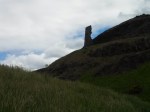



For my friends Amy and Camille who are not on Facebook! I knew if I just posted the picture there you’d never see them. So it may take a week or so before I wrote up all of my TED notes, I figured I could at least write up some of the non-conference details.
Today we have a late start for the TED Global conference, which is super nice as it gave me time for a good 2-hour walk.
Edinburgh is a gorgeous city. All tallied I have spent about 3 weeks here and have seen loads of beautiful things. But beautiful doesn’t always fill 2 hours so today I decided to walk to the sea. So I set off from my hotel (which is amazing and super centrally located) and headed north. I love UK cities so it was fun to walk by the regular shops and pubs, and off licenses and tattoo parlors – although I soon realized I was walking by more pubs and tattoos than say libraries.
Then I got close to the sea, which it turns out is pretty industrial. To be fair I knew the potential for industry so close to the city. But it was a great opportunity to check out a Scottish junkyard, landfill and recycling center. (Wish I could capture a smell in a camera!) But all of that industry is just a short walk from the sea!
The highlight was walking between the sea and the storage rental spaces. And those of you who know me well will know that I don’t love dogs. So image my delight when I could hear the mean storage security dogs going crazy as I walked past their domain.


I’m 62 minutes away from home according to the GPS. It’s been a long day but a fun vacation. We had an amazing time in New Orleans and managed a few fun stops on the way home.
It started last night in Jackson Mississippi. We had a quick (but really good!) dinner at Babalu. The dinner was so quick I decided we could take some quick pictures at the Jackson State Capitol. It’s pretty. Actually we were quite impressed with Jackson. On the way to New Orleans we stopped at the car wash – this time we were in the high brow neighborhood. Very nice houses.
Then we plowed through to Memphis with one plan in mind. We checked out Graceland Memorial Gardens because well, first Graceland is cool. But more importantly given the posse with which I roll, it is free to visit the gardens if you come between 7:30-8:30 am. How cool! We got to check out the grounds and see Elvis’ grave. It was more than enough for the girls. It got them out of bed early and helped us get on the road. I’ve visited Graceland before and would easily visit again – but again given our crowd the quick, cheerful and cheap tour was best.
Then we drove forever. We had a nice dinner in Iowa City. (I know, who knew?) We stopped at a place on the campus called Graze – nice small plates. Then I learned about Devonian Fossil Gorge. It apparently an inland sea that has dried up a few times (in the last 15 years) resulting in tons of fossils. It’s probably a lot better when it’s warm outside. Although it was very close to the city, very easy to get to, a good break for folks who have been in the car – just if it were a little warmer.
Now we’re just waiting to dock at home!
Filed under: New Orleans
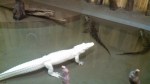
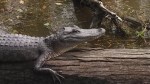
Easter Sunday we woke up and went to the swamp for an alligator hunt on an air boat. Remember the big swamp boat with the propelling fan at the back from that old 70s show Flipper? Well that’s what we were on. It sat about 15. Aine scored the seat of honor at the top near the driver. I was very jealous and must learn how to cute it up for next time.
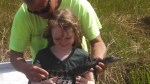
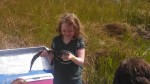
Kate was really the driver for checking out the alligators. And it was a really good call. It was so much fun! Not necessarily cheap, but I’d do it again in a heartbeat. The swamp we visited was family-owned and used primary for the tours. We were one of about 6 boats that seemed to be out on the swamp. But it didn’t feel like Disney ride or anything – I think we all felt that we were on a hunt of sorts. We saw tons of alligators and some turtles, bald eagles and cows!
I learned a few things about alligators – so I have my fingers crossed for it being an upcoming Pub Quiz topic! Here are some of the more interesting (or at least memorable) facts:
- A baby alligator has 1-2 percent chance of making it to 6 feet (adulthood)
- Alligators like white food – like marshmallows
- An alligator egg is worth $18-22
- It takes a 6 foot alligator to make a boot (a pair of boots starts at $1200 – I wear 6.5 if you’re shopping!)
- There are 3.3 million alligators in Louisiana
- A bayou is a path through the swamp
But mostly the trip was just really cool. It was fun to be in the boat thing. It was fun to see – and hold – an alligator. It was fun to see terrain so different from what we’re used to seeing.
After the swamp tour we quickly got gussied up and headed out to the Easter Parade in the French Quarter. We thought we’d see it for a few minutes but the parade wound its way around the French Quarter as we snuck in out last must-do activities before hitting the road. Aine got a ton of necklaces. The floats toss out beads and other trinkets. And we finally got to try the beignets – which were delicious! And we soaked up the last of the fun spirit and sunshine of New Orleans.
Our funny last look was the fact that we had almost no gas when we got back into the van. Something we didn’t pay enough attention to – until we found ourselves on the raised highway above the swamp. There are no off road locations when you’re between a lake and a swamp. Also everyone melted down a little once we got into the car. So we have people spraying perfume, complaining about plugins (mobile wifi we can share, plugs, not so much), whining about being hungry (delicious as they are apparently beignets aren’t really lunch), a big rain storm started and we’re worried about running out of gas. Luckily it didn’t happen. We got gas, food, power, sleep and remembered rain isn’t like snow even if everyone in Louisiana seems to drive like it is.









Filed under: New Orleans
Our second day in New Orleans started with a tour of the Voodoo Museum. It was pretty cool – in my favorite vein of creepy but cool. We learned a lot more about top Voodoo Queen Marie Laveau. We saw a working alter and lots of paraphernalia. We learned that many Catholic Saints have sort of become Voodoo symbols – or maybe it mostly has to do with the statues of the saints. Either way I sort of liked the connection. Lily had a great interest. Aine was a little nervous in the museum. The woman working at the museum was very nice.
What was cool was that we could take pictures – so I took a bunch. The girls were *not* interested in being in the pictures since Reverend Zombie’s Voodoo shop had made a point of saying that taking pictures was entirely forbidden.
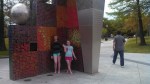
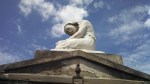
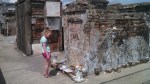
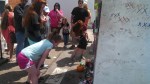
After the Voodoo museum, we couldn’t pass up the cemetery where Marie Laveau was buried. Well, buried isn’t the best term. Entombed is a much better term. Burying the corpses doesn’t make sense when the city is built on swampland. One good flood and you could see where the idea of zombies could spread. The tombs are different. We saw one modern-looking tomb that was shaped like a pyramid; mostly they look like European tombs. I have some pictures of Marie’s tomb, although there seemed to be some dispute about which was actually hers. It sounded as if both the contenders were family vaults, but unclear which was hers. As you can see from the pictures, people leave keepsakes by the tomb. You make a wish, leave an item and if Marie likes the item, she’ll grant your wish.
We also stopped by the Louis Armstrong Park. Very nice area with great fountain and modern art all around. Really it was just to be a little hot for a change.
In the afternoon we took the free ferry to Algiers, which is really just a hop and skip over to the West side of the Mississippi – but who can turn town either free or ferry! It does give some really nice views of the city. And it seems as if Algiers did not have the flooding that the rest of New Orleans had during Katrina – so the houses are beautiful and unique with beautiful gardens. And cats. The number of cats actually got a little creepy. (In fairness, I can find one cat creepy – and never cool!)
On Algiers we found a British Pub. It had something for each of us – the front door was a TARDIS (that’s the time travel machine from Dr Who for those who went to the prom), Dr Who played on the TVs inside, they had nice pints and Wotsits, which are my favorite British crisp-type thing. (They’re like cheese puffs.)
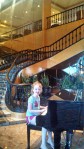
After the super quick trip on the ferry, we went to the 11th floor of the Westin for another great view of the city. You can sneak up to the 11th floor from the shopping mall beneath (very near to our hotel). On the 11th floor is the hotel lobby, which they seem happy to share with non-guests. The view was gorgeous.
After that we seemed to roam the city aimlessly for hours – eventually finding a fancy dinner at the Hotel Montelone.












Filed under: New Orleans
Dad and I started the day in New Orleans with a good walk around while girls caught up on sleep. We checked out the French Quarter and picked out some good places to eat. We even crashed a Good Friday parade.
We started with an amazing brunch at The Court of Two Sisters on Royal Street. The have a live jazz brunch every day. The food was amazing. Tons of peel and eat shrimp and some other stuff. Actually while I could be happy for a long time with peel and eats – everything was really good. And the jazz was just the perfect amount. We were about 5 feet from the musicians – but it was fun, not overwhelming.
Then we checked out the French Quarter. We saw some buskers. Aine was selected as the magician’s helper, which is always fun. She did a good job. We saw tons of shops – including Reverend Zombie’s House of Voodoo, which caught Lily’s eye. We saw some great musicians. There’s not a ton to report – but we had a great time. It was nice to be warm and at times actually hot. It was easy to see why New Orleans is called America’s best foreign city. It’s a good city for walkers. There are lots of nice places to eat – inside and out. Stuff feels old.
Not having visited before Katrina, it’s tough to say if anything was different. There are places that are boarded up – too many really but I can’t say for sure that’s all Katrina-related. There are many super gorgeous balconies and intricate ironwork and flowers hanging from above – despite frost warnings earlier in the week.
Patrick flew in Friday night. So we all checked out Orleans Grapevine Bistro, which was another amazing meal. We walked back around Bourbon Street, so the girls got a flavor of the scene – but not too much. The Patrick and I hit the town. We ended up on Frenchman Street watching a great band. Their encore was a great version of These Boot were Made for Walking. And one of us got asked to dance several times. I won’t say which one.
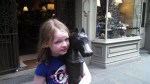
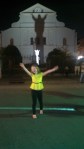
I do have to note one of my favorite pictures – Aine in front of the St Louis Cathedral with the big shadows!




Day two on the road to New Orleans. Not a ton to report. We had brunch at a place called Brother Juniper’s in Memphis. Monte Cristo with maple syrup – nonstandard, yet really good! Then we tried some car washes in Jackson. And we drove a lot. We saw snow until nearly Memphis – which was a little sad.
We arrived in New Orleans in time for dinner. We ate at a place called Mother’s. Apparently it was on Man v Food. Man tried to eat the giant Po’ Boy. We didn’t. The food was good. Poor Lily had nothing to eat with Mother’s does no specialize in vegetarian dishes.


OK I’ve been *terrible* about the blog and maybe I’ll go back and fill in the last few months – but today I’ll at least pick up to talk about our 2013 Spring Break. We drove down the New Orleans with Grandpa and back with Patrick.
The trip seemed a little ill fated at the onset. Poor Aine was sick – begging to stay home, which is very unlike Aine. I forgot my charger, so we had to go back. Grandpa forgot his sunglasses, so we had to go back. But after a series of false starts we were on the road. First stop – Cedar Rapids, Iowa. We had a fancy French lunch – well not really fancy, but pretty French.
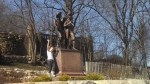
Then we made a pit stop in Hannibal Missouri, boyhood home to Mark Twain (aka Samuel Clemens). We took some pictures at the commemorative lighthouse – which is kind of strange in that it way up on top of a hill. Kind of bad placing it seems for warding off ships on a stormy night. Seems like it might be more useful to low flying planes. It was fun to see the town. Most of us got an ice cream treat and Grandpa showed Aine how to play some brain teaser game at the ice cream parlor.
Three facts about Mark Twain:
- He was born in 1835 and the lighthouse was built 100 years later
- Twain was born and died during a visit from Halley’s comet.
- The name Mark Twain comes from his river boat days, it is the cry for a measured river depth of two fathoms
Next stop was St Louis. We had an old school Italian dinner on Italian Hill. We felt almost like interlopers when we were the only ones that the host didn’t know by name! Then we caught the big Arch as night was falling. It was cool – much more silvery than I expected.
Three facts about St Louis’ Gateway Arch:
- It is 630 feet tall
- It is 630 feet wide
- It was built from 1963-65
We spent the night in Cape Girardeau – a new town for us. Actually I think Missouri was a new state for the girls. So that’s always fun!






 10 Questions About...