
The third day of TED started with a focus on international. Pankaj Ghemwat started with an interesting statistics – only 2 percent of phone traffic was cross border. I don’t know if that includes Skype. I can’t even remember what the scope of the test group was – but I found that amazing. Although I suspect that except when I’m in Ireland less than 2 percent of my phone traffic is international. The same can’t be said of my email or Facebook traffic.
Robert Neuwirth spoke about System D – essentially off the books economic activity, especially happening in third world (hopefully emerging) economies. I find this fascinating – and love to hear about the ingenuity and entrepreneurship of folks in stressed economic environments and I hate to hear about what the folks on the “right side” of the economic divide are willing to do to maintain the status quo. System D may not be pretty – but I think it lifts a lot of people to a better place – making room for the next generation to make it pretty!
I was surprised how much I enjoyed Alex Salmond (Scotland’s First Minister) on the power of small countries. Without a doubt, it’s the time I spend in Ireland that makes the toptic interesting to me. But like small businesses I think the small countries have an agility that the US has totally lost. And I think agility is more important now that it ever had been in the past. I wish the US would be open to hearing about agile strategies. For folks who don’t know, Alex Salmond would like to see Scotland separate from England. And I found him interesting – but someone asked why Sctoland should separate and he didn’t have a good elevator pitch answer. I think he needs to work on that. (And I’m sure he’s reading this post for my advice!)
Ivan Krastev spoke about governments – he was entertaining – coming as he said from a country of pessimists, Bulgaria. One comments he made the struck me – We can change governments but not policies.
Gabriella Coleman gave a super interesting talk on AnanOps – a group of cyber vigilantes who have been known to take down folks/groups that they feel have earned some agro. I think they’re like Alex in Clockwork Orange or other antagonists who build a subculture hero status by using nefarious tactics sometimes to right a wrong – but sometimes just because they can. One interesting thing about the AnanOps is that membership is open and anonymous – so to even talk about them as a group is difficult.
Leslie Chang gave a great talk on the life of factory workers (women mostly if not exclusively) in China. Her point was that measuring the life of factory worker by US or most European standards wasn’t really fair. The women are working under what I would call horrendous conditions – but the conditions are much better than what they have left in the country and the factory jobs allow them to make major improvements in their lives – and like System D – while the picture isn’t pretty it improves the lives of subsequent generations. I think in the US we’ve lost the appreciation of working for the next generation.
Neil Harbisson was a walking cyborg. He’s color blind – but he has created adaptive technology that allows him to hear colors based on the tone of the frequency those colors generate. Reminded me of many exhibits I’ve seen at the Science Gallery – very cool but I don’t entirely get the direct translation from color to sound. That being said I do appreciate that once you create a standard you can develop a system for translation that can be understood universally so I applaud the effort. Also his geometrical art, based on mathematic-created colors was amazing!
In the afternoon we heard from some more amazing people – a couple of whom had learned to cope with sever metal illness, such as chronic schizophrenia. Elyn Saks spoke about her experience being committed against her will as a young woman and how she went on to get a Phd and live a productive life thanks to medication, a strong support system and an occupied mind. (And I’d add a strong will!) Ruby Wax gave an entertaining look at what it’s like for a brain with issues. Vkiram Patel introduced SUDAR – a tool that will help deploy mental health treatment to patients all over the world through channels that don’t require high level medical staff, which often aren’t available. I love his idea of democratizing medical knowledge. We learned of a few examples. The gist is sort of DIY kits that help semi-trained or maybe even just compassionate people to support to offer medical service to others. Sometimes (as in the case of SUDAR) it’s a matter of rough and ready training for the care giver; sometimes it’s a matter of easy-to-administer medical exams or medication.
We also heard from Rob Legato who did the special effects for Apollo movies (and others but not being a movie person I can’t remember them). He had a fun story of how he recreated the first rocket launch – first they used footage to create an replica and everyone said it was wrong. So they surveyed loads of people – who remembered things incorrectly – but they observed trends in the misremembering. Then they built the second launch as people remembered it and everyone thought it was great.
In the evening we learned about renewable energy projects – which again I loved! We heard from Jonathan Trent (from NASA, who I talked to at a party!!) who talked about Project Omega, a very cool way to tap into biofuels under the sea – in a way that’s respectful to the sea and the surrounding community.
Sarah Jayne Blackmore spoke about how the prefrontal cortex develops through adolescence. Here’s some shocking news – teens have difficulty understanding other’s perspective! Well, it was good to hear that it’s kind of out of their control anyways – not just willful crabbiness, which is what I had previously assumed.
The night ended with my friend Preston Reed playing with Usman Riaz. The music was amazing! But the best part was the visual. Usman is a virtual apprentice to Preston’s style of percussion guitar. Usman learned to play that way via YouTube videos of Preston. Preston is huge with long greyish hair – he plays standing up. Usman is slight with dark hair and plays sitting down. If I were a painter and I wanted to capture a modern day apprentice relationship – I couldn’t do much better than painting them on stage. Plus they both have such a generous and modest stage presence. (Think *big* smiles after each song – while super serious faces while they play.) I’m going to cheat and use video from a TED After Hours event here – since no filing during TED!
I’m realizing that deciding to type up all of mu notes from TED is sort of handicapping me from adding any notes – so I’m going with highlights.
The day started with a couple more TED Fellow and TED University talks. Jill Blakeway spoke about the placebo effect in acupuncture – and how she learned to embraced the idea that acupuncture might be a placebo. I like that idea – mostly so long as something does no harm I’m all over any effect, placebo or otherwise! Then Margaret Stewart gave a wonderful demonstration on sabering champagne bottles. I wont’ say too much as I plan to perfect it once I get home (and can buy champagne with dollars) and impress everyone.
Then the Big TED event began. I have to start by saying that all of the speakers were wonderful. I think choosing favorites is really a matter of what topics interest you. And the following interested me…
Raghu Dixit – an amazing musician from India. He got everybody up and clapping – if not actually dancing.
James Stavridis, – NATO Supreme Commander – yup no typo there, that’s who he is. He spoke about open source security. The idea being that building bridges will be more effective than building walls but that it requires public-private partnership. Nice to hear someone from NATO promoting that idea. I loved the grouping of speakers – but in retrospect, his talk really fit in well with Jason McCue’s talk on terrorism.
Massimo Banzi – creator of Arduino. If I were a coder I’d be all over this and the idea of taking open source to such a degree as to make everything available to be improved upon. The whole idea of open source is such a game changer in terms of how economy works.
Lee Cronin – print your own medicine. Wow! This was a recurring theme both at TED, Dublin Science Gallery and other things I’ve been reading. The idea that you can create custom chemicals through these printers is amazing. Take it a step further and since you’re creating small batches, it opens the door to creating personalized medicine. So maybe I get a special aspirin that we know won’t react poorly to my eye medicine. Or on a broader scope – imagine the possibilities to thwart the danger of viral diseases.
Daphne Koller – open access to education – allowing anyone to take online (real time) classes from top universities https://www.coursera.org/ – this might shift the goal of education from getting the degree to learning the lessons – never mind the opportunity to level the playing field – for anyone with the broadband to take advantage of it.
Eddie Obeng – one of my favorite speakers! He spoke about reacting to a world that no longer exists. The problem is that we have our regular ways of doing things – from education to running a business. Unfortunately the rules in which those ways were created have changed entirely (see Arduino above) and we’re not changing with them. We need to break away from the regular way to create new ways that take in account the changes that are happening. He speaks about the smart failure!
Karen Thompson Walker – the idea was that fear is intellectual story – we need to learn to read our fears – but the story she told was gripping. Look for her talk when it comes out!
The night ended with a great party at the Scotland Museum, which was very fun. I met some super friendly guys (Rob and Richard) so I had folks to hang with. And we headed to the After Hours event which starred the TED performers Raghu Dixit in a place called The Caves, because it appeared to have been built into caves below the castle.


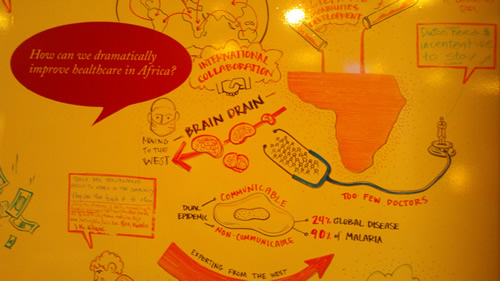

Filed under: Edinburgh
I can’t believe I didn’t write about our fancy first night party for TED. It was held at the top of the Edinburgh Castle. The weather was perfect! The drinks were free. Folks walked around with wonderful appetizers. Everyone was friendly.
There are people who serve as hosts. I think they’ve probably just attended a billion previous TEDs – but they are super friendly and when you’re new to the event and you’ve come alone, it really is nice to have the super friendly people start conversation. And of course this was just a couple of hours after my presentation so many kind people came up to say hello to me based on what little they had learned about me. So that was super nice too.
I took some pictures from the castle – but admittedly they don’t look nearly as good as the real thing. But while I was taking pictures I met someone from Catalonia. (Patrick and I taught English in Catalonia before we were married.) You don’t meet a lot of people from that area. He was very impressed that I had lived in Mollerusa- well if not impressed at least surprised. I have to say that at an event like this it is nice to have done a little traveling.
Just as the castle party was ending I found myself talking to some great people – and we trekked to a nearby pub. For better or for worse this began a happy habit throughout the conference. I’m including various pictures from various nights of me, Cath, Preston and Liang. And I must thank them for helping me ring in my birthday after midnight on that firs night of TED!
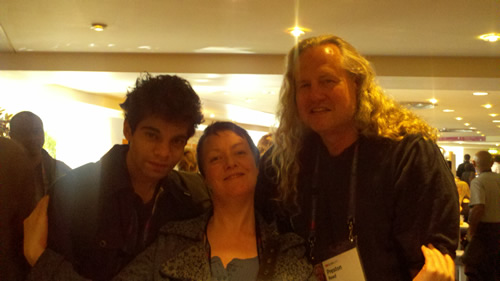


Everyone said there’d be a letdown or deep depression post TED – so far I still just feel so super lucky to have gone and participated. I do wish that I had a few days to just reflect and let it all sink in – that so far that’s not happening either. But today is the 4th of July. We went to the beach to celebrate Aine’s birthday and I got a good chunk of work done so I’m rewarding myself with time to write up notes from at least the first session I attended last week.
Day One was really a pre-conference day. There were talks from TED Fellows and the TED University. TED Fellows are a select group of folks doing cool things who get to attend TED events and get special TED support. TED University folks are super lucky members of the audience who are selected to talk. (I wrote about my super lucky TED University Talk earlier.)
Here are my very rough notes – again they’re mostly for me but anyone is welcome to read them.
Usman Riaz – an amazing musician. I’ll write more about him as he was on the big stage too with someone who became a friend at TED.
Catarina Mota – spoke about open source hardware. Companies should give away design blue print with the idea that others might improve it and/or customize it based on personal needs. As she pointed out today hardware is pretty inflexible so we bend to meet it rather than creating hardware that bends to meet our needs. It’s a good point – we’re too smart to use one size fits all hardware solutions.
Aman Mojadidi – spoke about the geography of self. He is an artist who takes conflict chic photos in Afghanistan. Think Kid Rock fashion with Taliban sensibilities.
Max Little – he had a super cool invention that was able to predict Parkinson’s Disease based on voice modulation. So folks at home could simply make a phone call to take the test – the voice patterns enough were a strong indicator, enough for his test to predict evidence of Parkinson’s. Very smart! And a fun fact, that morning his story ran in the BBC, he was overwhelmed with offers and attention. So he was swept into the BBC immediately following his talk. Then his wife (back home) had a baby that night. That’s a big day!
Kristen Marhaver – talked about coral reef – reminded me of the women who talks about coral reef and hyperbolic geometry – except this is more on coral reef. It was interesting to hear about how life choices made so early in the life of coral reef are determinants for longevity. She is looking into how/why coral reef decide to settle where they do.
Eric Berlow – works with the Vibrant Data Project tracking food chain and data democracy challenges. His folks is on ecology.
Bel Pesce – spoke about how she went from Brazil to getting into MIT. Clearly her energy was a big player.
Juliette LaMontagne – has developed a cool experiential learning program called Breaker where students (age 18-24) become social entrepreneurs. As a group they take on a challenge together to make the world a little better and to learn how to make things happen.
Salvatore Iaconesi – is an artist who spoke about augmented reality and the idea of using social media as a democratic tool. Specifically folks in dangerous areas (think demonstrations) could use their mobile phones to track how to get out of dangerous spots. I think of how valuable that would have been to us during the Republic National Convention demonstrations in Minneapolis last election.
Andrew Nemhr – amazing tap dancer. I happened to get him and another fellow (Meklit Hadero) at one of the afterhours events.
Alexander Mclean – is working in prisons in Africa to make life better for prisons – especially important because so many people are wrongfully imprisoned and/or unjustly punished.
Ed Ou – a photojournalist who remarked that youth are always an entry point into any culture. He took pictures of planning and deploying of demonstrations. He had one amazing shot of the planning of an event. He asked for permission to publish – because obviously the people in the picture would be in danger. They were all young and activists. Turns out that one young woman got into trouble from her parents – since she was smoking in the picture!
Candy Chang – she had some of the most amazing public art / public thought projects. They one I liked was simply the chalk boards that started with “Before I die…”; many people came in to fill in the blanks on that large installation. The best was the picture of the guy dressed swash buckling clothes writing – “I want to be tried as a pirate”.
Elaine NG – spoke about shape memory and giving life to materials. She worked with materials so that they seemed to breathe and/or react to touch. She reminded me of some of the exhibits we’ve seen at the Science Gallery.
Hakeem Oluseyi – is working ot get more decent telescopes in Africa. Apparently there are only 3 good telescopes in Africa – which seems insane given the view they must have of the night sky.
Joel Jackson – has developed an affordable car for poor areas. He has stripped out the unnecessary features leaving a car that costs $6000. The idea is to sell them to entrepreneurs who can use them to start or build their businesses.
Ivana Gadjanski – is looking into poison calcium channels to prevent MS.
Juliana Machado Ferreira – found an interesting way to track bird traffickers and trafficked birds based on the DNA of the birds.
Sheref Mansky – works with Synthetic biology and coming up with new ways to create components.
Ola Orekunrin – she is the founder of Flying Doctors in Nigeria after her sister died waiting to get to a hospital – she spoke about living at the speed of life
Skylar Tibbits – is reinventing the way we build things with self-assembly kits
Christopher Soghoian – talked about how easy it is to hack into the cell phone towers by pretending to be a cell phone tower. One of the problems is that cell phones are programmed to communicate with any tower. There’s a need for better authentication. And one of the reasons this is becoming a bigger issue is that it’s not quite cheap to pretend to be a tower.
Bahia Shehab – is an Lebanese-Egyptian artist who builds are based on Arabic script for no – her project is called 1000 times no. It was kind of amazing to see such a seemingly quiet woman who has posted essentially thoughtful graffiti in dangerous places saying NO.
Robert Gupta & Joshua Roma – amazing musicians
Then I lose a lot of Monday afternoon getting ready for my talk. You can get notes from the TED University talks on the TED blog. Here are my quick notes…
- Nilofer Merchant spoke about how sharing ideas opens them up to greater returns.
- David Mismark – spoke about randomness
- Laurie Coots – spoke about social justice and activism especially with young people.
- Paolo Cardini – spoke about single purpose devices – like a phone just being a phone
- Manu Prakash – created a printable microscope – amazing for poor counties
- Alanna Shaikh – spoke about how she’s preparing to get Alzheimer’s (she will get the test when she’s 40 – super interesting woman)
- Nina Tandon – spoke on 3 reasons to grow human tissue – such a poised and impressive woman
- Melissa Marshal – her talk about “talk nerdy to me” great title, great point on getting geeks to communicate
- Meklit Hadero (see video)
- Anwar Dafa-Alla – spoke about his translation work, especially for TED – amazingly friendly person
- David Binder – spoke about theater festivals. Wish I had been able to talk to him for Patrick.
I’m hoping to write about TED in the next week –mostly so that I have ready access to the notes, but of course anyone is welcome to read them. Lots of people have asked about the TED Talk so I thought I’d start there.
Update Feb 26, 2018: That talk is now online:

Image courtesy of TED Global
I decided earlier this year that I wanted to go to TED Global – so I applied and got in and that was pretty exciting in and of itself. Then they sent out a message inviting people to give talks as part of the TED University. To be a big TED speaker is a *huge* deal. I thought there’d be no way I’d ever be selected to give a TED U talk. (Being a TED U speaker was a tremendous honor – but lest readers get the wrong idea – it’s not like being a planned TED speaker.)Well June 3, approximately three weeks before the conference I got the email (which I read 1000 times) inviting me to be a speaker. I don’t know how many apply; about 12 were selected.
The title of my talk was Ready, Shoot Aim. (Rick B came up with that very good idea!) I had exactly 3 minutes to talk. The TED people could not have been nicer! I wrote several versions of the talk – you know between work and getting ready to get the girls and myself to Dublin. (Patrick left a month earlier.) Then I had an unfortunate situation happen on the way to Dublin – and I trashed the talk I had written and used the incident instead.
The incident: I totally screwed up our flights to Dublin. On Thursday I looked at the tickets thinking the flight was Friday. It was Wednesday. So it was an opportunity to get ready, shoot and aim.
Luckily I spoke on the first day – or I would have missed the whole conference due to worry. All of the TED U speakers gathered at the Lyceum at noon to get a feel for the space. Then we came back around 3:30 for hair and makeup. I went on at 4:40. Before me was a PhD from MIT who had developed a printable microscope. The woman after me spoke about how she is planning to get Alzheimer’s because her dad has it and spoke on the changes she is making in her life in preparation. I was totally out of my league.
I gave the talk. I don’t really remember the experience. I had memorized the talk. Not my favorite way to give a talk. I had no visual aids. I went over my time – in fact I cut our about 20 percent of my talk because I noticed the blinking lights. I thought I’d get comfortable when I was up there. I didn’t. In fact it took about 2 hours and a 20 minute walk back to my hotel to quit shaking. It was totally like going off the high dive – glad I didn’t chicken out, but at that point I wasn’t so sure I was glad I jumped either.
BUT I am glad that I did it. It gave me an opportunity to meet a cohort of sorts off the bat, which was nice. Also, it was a good excuse for people to come up and talk to me. People are really kind. Lots of people said nice things. I got to hear about everyone’s travel mishaps and I found out that librarian is a very popular profession in the TED world – popular as in people liked that – not that there were many librarians. At the conference I spoke with loads of people – but just a handful became friends on any level – and I got to know one set friends because they stopped me and asked about my talk.
The woman who spoke about her Alzheimer’s plan told me that she got to hear all about people’s death stories. In that respect I was glad to have gone lighter. Although her talk was so good, she just may find herself on the big TED website. I will not. Although in about 6 months they will be posting all of the TED U talks on the TED U website.
I still can’t believe I was selected – but I couldn’t be more thankful that I was.
Filed under: Edinburgh
Day two in Edinburgh was more ups and downs. (Remember, built on 7 hills.) We started at the Camera Obscura. It’s kind of a museum of optical illusions. My favorite part was the telescope on top you could work remotely from inside . You could zoom in on things all over town. I loved that. There was a giant version the guides could use to give us a lazy man’s tour of the city. We loved it. Here’s a definition of Camera Obscura from Wikipedia. I thought it was interesting…
The camera obscura (Latin for “dark room”; “darkened chamber”) is an optical device that projects an image of its surroundings on a screen. It is used in drawing and for entertainment, and was one of the inventions that led to photography. The device consists of a box or room with a hole in one side. Light from an external scene passes through the hole and strikes a surface inside where it is reproduced, upside-down, but with colour and perspective preserved. The image can be projected onto paper, and can then be traced to produce a highly accurate representation.
After Camera Obscura we went on a underground ghost tour. Soon after the tour began we realize why there weren’t more kids in the tour. The tour takes place in a vault underground – it’s part of Edinburgh’s underground city. The vaults were originally built by merchants for storage but they soon learned that the caves we too porous to be useful. So there were abandoned. In the 1700s Edinburgh became over populated. They made it illegal to be homeless, punishable by death. So the homeless moved to these underground vaults. The life expectancy of a grown man was 18 months once we moved to the vault. I won’t go into gruesome details – but it was really sad to just think about the conditions. One of the vaults is currently used by a Wiccan group. There were some scary stories about why the Wiccans move from one room to another. The tour guide had a great, super scary delivery. It took about a hour for the girls to talk to us after this tour. Although – and I want it on the record – this was Patrick’s choice, not mine! As revenge I am including the picture of him in the vault. It’s one of the few pictures that turned out.
After the creepy tour we headed to the Scott Monument. It was built in the mid-1800s and there are 287 steps to the top. I got to about 250 and had to turn back. Partially because I just couldn’t stomach Aine running around completely oblivious to the height. I can’t believe that we weren’t scooping her up off the pavement – although in fairness there really wasn’t an easy way to fall or jump out of the tower. Lily, Aine and Patrick made it to the top of the tower.
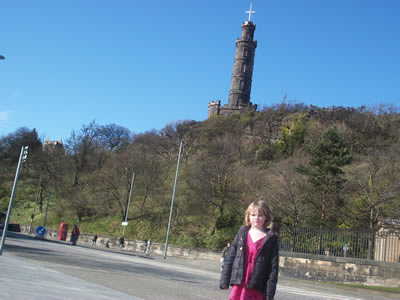
Then we went to Calton Hill. There’s an old observatory there – and some towers and ruins (Nelson’s Monumnet) that nearly look like they are from Rome. Like the day before on Arthur’s Seat, it was just nice to be out in the great weather climbing aorund. Aine particularly enjoyed it. Patrick pointed out that it’s fun to see all of the old emperial statues and mouments. For better or for worse those seem to get blown up in Dublin so there’s not a lot left.
We capped off our day with a fun Thai meal.
Filed under: Edinburgh
So it turns out that we should have come to Scotland a long time ago! We have had an amazing time.
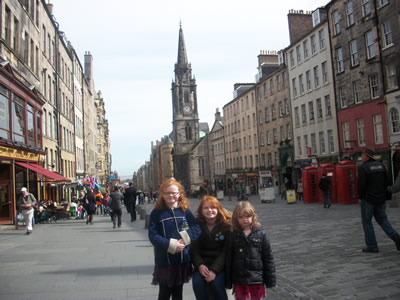
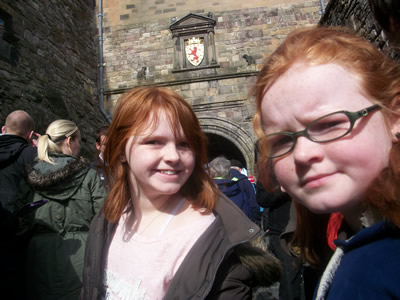
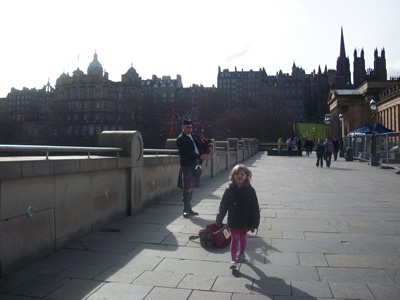
Edinburgh is very hilly; it’s built on 7 years. The castle is built on the top of one hill on one end of town. It looms pretty impressively over the town. In fact from our apartment we walked into town and kind of fell upon this amazing site. We all gasped! (First a quick note on the apartment. We have a 2 bedroom apartment with a sitting room, kitchen and big bathroom. It’s about a 10-minute walk from town. It is wonderful!)
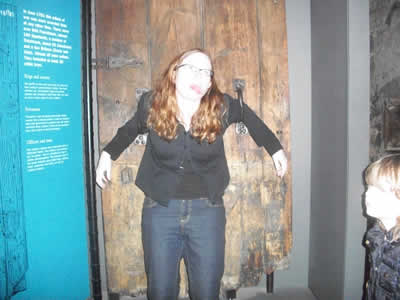
Anyways the city really does take your breath away. It’s one of those times when I wish I had a good camera because I just don’t think my fit-in-my-pocket camera did any justice to the scenery. We saw where the prisoners lived and were tortured. We’re always suckers for torture – of others. But mostly we were overwhelmed by the amazing views.
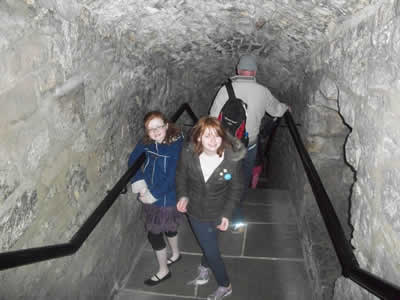
We decided to start with the castle. So we climbed up and up. It is huge. We took at tour and I found out how little I really know about Scotland. Most of it I learned watching Macbeth! We saw the crown jewels.
The Castle is at one end of the Royal Mile. At the opposite end is the Palace of Holyrood – between the two are a series of tourist shops, loads of tiny alleys, some cool old buildings. We stopped for lunch at The Elephant House, where JK Rowling started writing Harry Potter.
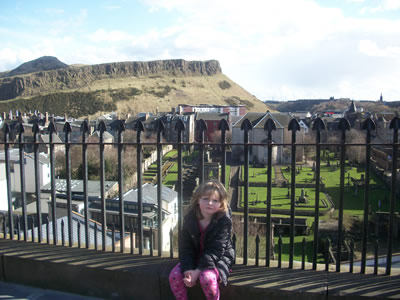
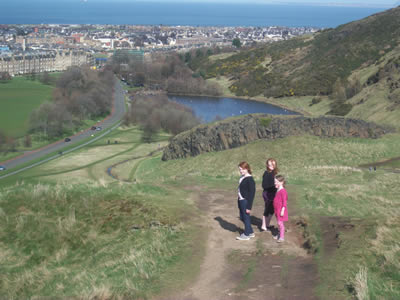
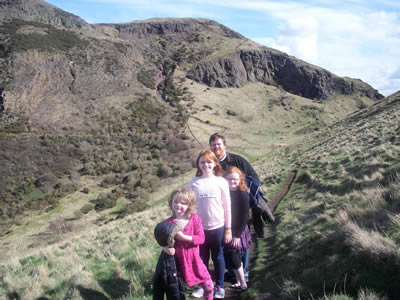
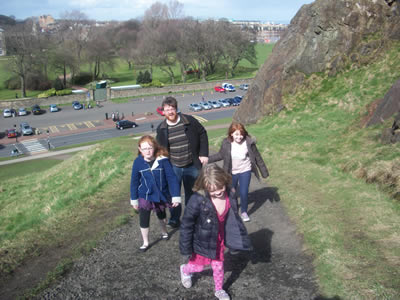
Then we walked down to Holyrood and as you get closer you can see Arthur’s Seat – an extinct volcano. We debated for about four second whether to see the palace or climb the mountain. We went fr mountain, which was spectacular. The best part of it was that we never really thought we’d get to the top. (For those in the know we really climbed up near the Seat of Arthur, not the tallest peak but one next to it, though in retrospect we could have gone for it.) Anyways we did climb the entire thing – in fact we climbed up and around the mountain.
I was so impressed with the girls. Kate was a little afraid that her asthma might be a problem but she toughed it out. In fact, she said climbing the mountain was her favorite part of the day. Both of the older girls had reservations about the height issues. And I’m happy that Aine didn’t run off the side of the mountain. She was actually kind of sad that the climb was so gentle – she wanted to be climbing up rocks.
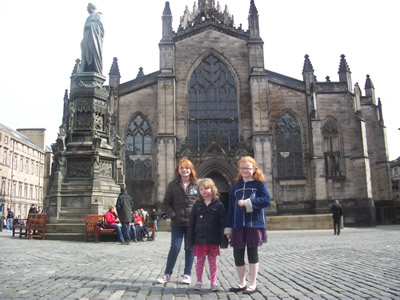
Then we kind of winded our way back to the apartment, We saw a statue of some relative of Guthrie. (Patrick can post a comment with details if he wants.) Patrick and I popped in a cemetery to see philosopher David Hume’s grave. The kids waited below where some Japanese tourist stopped to stare at them.
Then we went to a French restaurant called Chez Pierre for dinner. It was excellent – although even I have to sometimes marvel at kids who will order mussels.

















Filed under: Edinburgh
So it turns out that while Scotland is very near to Ireland on the map, it’s not so close on the ground. Actually I knew that going in but it certainly gives me time for blog posts!
We started out yesterday on a bus to town (Dublin), got a coach (fancy bus) to Belfast, took a taxi to the harbor, got a boat to Stanraer, now we’re on the train that takes us to the big train that takes us to Glasgow, where we’ll change trains for Edinburgh and probably we’ll end up in a taxi to the apartment in Edinburgh. Whew!
So far the boat is the favorite mode of transportation. There’s a kids’ play area, arcade, pub, restaurant, seats to watch movies and more. You can walk around the whole time if you want. Aine and Kate got their nails down. We had choice seats right at the back of the boat where we could watch Belfast get smaller and we could see land two hours later when we got close to Stanraer. The sailing was a little choppy – and they wanted us it would be. But – and I remember this from taking the boat from Holyhead to Dun Laoghaire years ago – it doesn’t seem so bad if you can get outside and see the water.
My Internet connection is spotty. I have a whole new appreciation for folks who are stuck with satellite. That’s what we had on the boat – I couldn’t do much. We’re going through rural Scotland now – I’m afraid Aine is going to hurt someone’s feelings by asking continually if we’re still in the middle of nowhere.
As long as this is, I’m glad that we have a chance to take our slow boat/bus/train/taxi trip. Obviously we spend a lot of time in Minnesota and Ireland. SO the girls know how life is different in each – but we don’t always have a good gauge on what differences are uniquely Irish or Minnesotan as opposed to European (or British) and American. For example Aine has asked me about a dozen times if there will be a pool at the hotel. (No there won’t be. As there is rarely a pool at the hotel in Europe and we’re not staying in a hotel, we’re staying in an apartment. Because there are apparently few to no hotel rooms big enough for a family of 5 in Europe.) I can generalize across Europe because we did look into visiting a few places – Scotland won.


 10 Questions About...